How to Choose the Best Custom Infrared Sauna in 2026: Complete Buyer's Guide
You are about to spend thousands on a sauna, and most listings tell you almost nothing useful. Heater type, EMF output, and red light placement are buried in spec sheets, while "custom" often means a stock cabin with your name on the order form.
This guide breaks down what actually separates a well-built custom infrared sauna from a marked-up kit in 2026. By the end, you will know which specifications to verify before signing, how red light proximity affects therapy, what construction details signal real quality, and whether SaunaCloud fits your needs, budget, and timeline.
What Is SaunaCloud? Who It's For and What It Builds
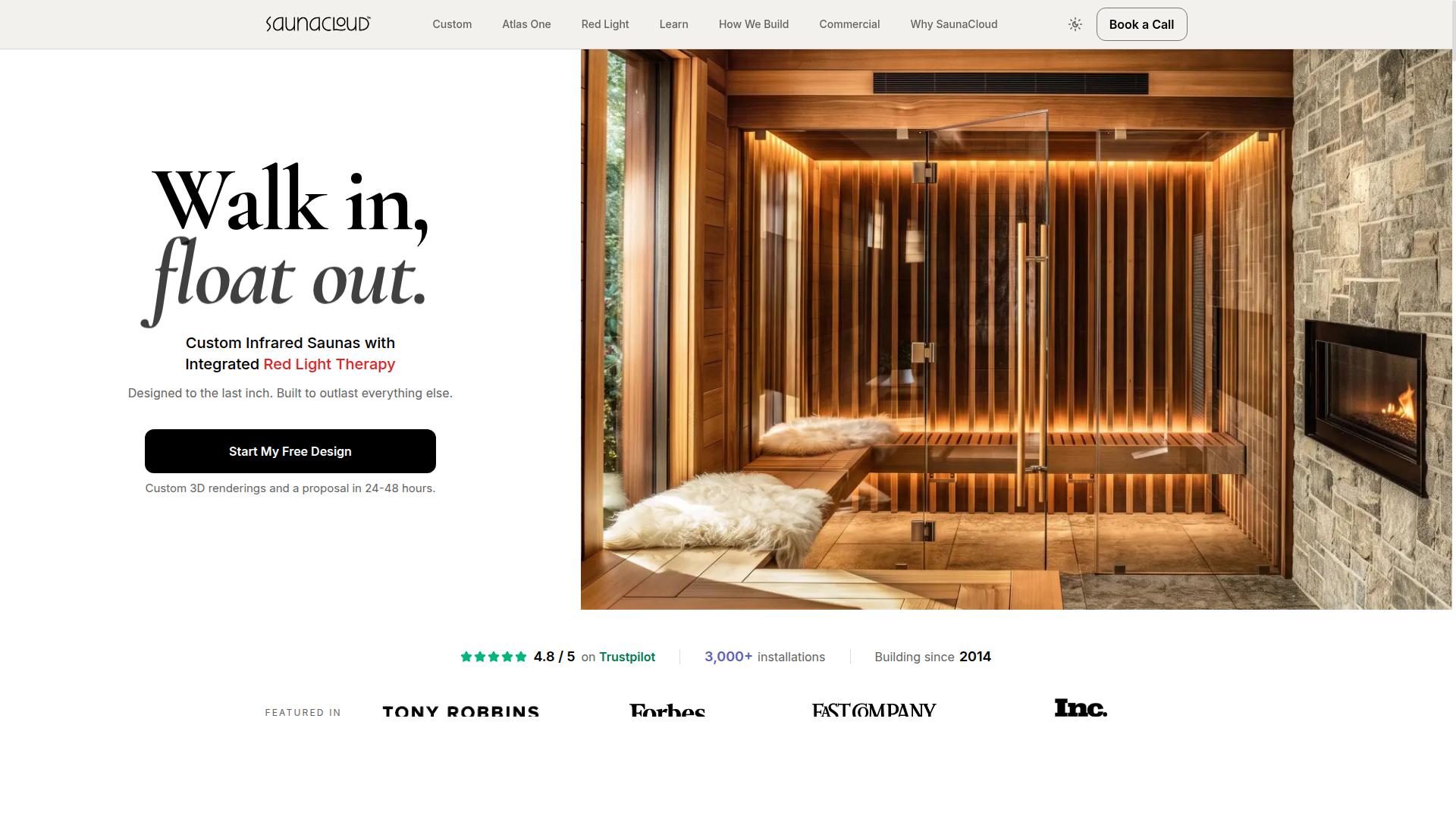
SaunaCloud is a California-based manufacturer that has been engineering and handcrafting custom infrared saunas with integrated red light therapy since 2014. The company operates from facilities in Diamond Springs, California and Montreal, Quebec, giving it a production and service footprint on both sides of the border.
Its core offering is a fully custom infrared sauna built to order, with the heaters, power supplies, control systems, and red light arrays all designed and built in-house. That vertical approach matters in a 2026 buyer's guide, because it means fewer third-party components and more control over how the finished cabin performs.
SaunaCloud serves homeowners, clinics, and wellness centers across North America, and has completed more than 3,000 installations to date. That mix of residential and commercial work is a useful signal for buyers weighing a personal sauna against a higher-use professional setting.
The sections below break down the specific models, the red light therapy integration, and the construction details that shape a buying decision.
Custom Infrared Saunas With Integrated Red Light Therapy
SaunaCloud's flagship offering is a fully customizable infrared sauna that incorporates clinical-proximity red light therapy directly into the bench and backrest areas. Two main models anchor the lineup: the Atlas and the Sierra. Each unit is built to order rather than pulled from stock, so the layout can be matched to the room and the intended use.
The red light arrays combine 660nm red and 850nm near-infrared LED therapy, positioned 2 to 6 inches from the skin. That close placement is what the company means by clinical proximity, and it is a meaningful distinction from panels mounted high on a wall or ceiling where distance reduces intensity at the body.
Heating comes from VantaWave® ultra-low-EMF carbon heaters, designed and built in-house alongside the CORE 5™ power supplies, printed circuit boards, and Wi-Fi control systems. Because these components are engineered together, the cabin is a single integrated system rather than an assembly of parts from different suppliers.
The saunas are positioned for recovery, pain relief, sleep improvement, stress reduction, and cardiovascular health. Buyers comparing options should treat these as the intended use cases the design targets, and match them against their own goals before choosing a model.
Construction details round out the product. Units use premium Western Red Cedar, and outdoor saunas are weather-sealed with cedar and stainless steel. Every order includes heaters, the control system, power supply, cedar, fasteners, and installation support, which keeps the scope of a build clear from the start.
What Makes a Custom Infrared Sauna the Best Choice in 2026
A custom infrared sauna offers tailored dimensions, heater configurations, and material choices that pre-built units cannot match, making it a superior investment in 2026. Buyers no longer have to accept a one-size-fits-all cabin that wastes floor space or forces compromises on where heaters sit.
Instead, a custom build lets you place heating panels exactly where your body needs them and select wood and finishes that suit your home. Integrated red light therapy is another reason custom designs stand out, since LEDs can be built into benches and backrests at the right distance.
This 2026 buyer's guide walks through the decisions that matter most: heater technology, EMF and wavelength benchmarks, red light placement, and sauna cabin construction. Each factor shapes comfort, safety, and long-term durability.
Heater Type, EMF Levels, and Wavelength: What to Verify
When evaluating a custom infrared sauna, verify the heater technology, EMF emission levels, and peak wavelength to ensure safety and effectiveness. These three factors determine how well the cabin delivers heat and how comfortable it feels over a long session.
Most saunas use one of two heater styles. Carbon fiber heating panels spread warmth across a wide surface, which tends to produce even heat and lower EMF output. Ceramic heater elements heat up faster and run hotter at the surface, but they can create more concentrated hot spots. Many buyers prefer carbon fiber for balanced, gentle warmth.
Ask manufacturers for specific numbers rather than vague assurances. Useful benchmarks include:
- EMF levels under 3 mG, ideally below 0.5 mG at typical seating distance
- A peak wavelength around 7.9 microns for far-infrared output
- Low ELF exposure, since magnetic fields matter alongside electric fields
- Independent testing documentation, not just marketing claims
When comparing models, request third-party test reports and ask whether the sauna carries a recognized low EMF certification. A reputable maker will share wavelength charts and field measurements without hesitation. If a seller cannot provide them, treat that as a warning sign.
Also confirm whether the cabin offers full-spectrum infrared, which combines near, mid, and far bands, or far-infrared only. Full-spectrum designs add near-infrared therapy for surface-level warmth, while far-infrared heaters penetrate more deeply. Neither is inherently better, but the choice should match your goals.
Red Light Therapy Proximity and Placement
For red light therapy to be effective, the LEDs must be positioned close enough to the skin, typically 2 to 6 inches, and placed strategically on benches and backrests. Distance matters because light intensity drops sharply as you move away from the source.
Clinical studies often use short distances to ensure adequate irradiance reaches the skin. In a sauna, that means integrated placement matters more than raw LED count. Panels built into the bench surface and lower backrest keep the light close during a seated session.
Ask two practical questions before buying:
- Is the red light therapy independently controlled from the heaters, so you can run light without heat?
- Which wavelengths are used, such as 660nm red and 850nm near-infrared?
Independent control adds flexibility and lets you extend a light session without overheating. Wavelength choice matters too, since 660nm targets surface tissue while 850nm penetrates further. A well-designed cabin may combine both for broader coverage.
Check that LEDs sit at a consistent height relative to where you actually sit, not just where the bench looks best. Uneven placement can leave some body areas under-exposed. A custom layout lets you adjust this before the cabin is built.
Materials, Construction, and Build Quality
The best custom saunas use solid wood construction with tongue-and-groove paneling, non-toxic finishes, and dual-wall insulation to maximize heat retention and durability. Materials affect both how the cabin ages and how efficiently it holds temperature.
Interior wood options each have tradeoffs. Canadian hemlock offers a clean, light grain at a moderate cost. Western red cedar resists moisture and carries a classic aroma, while a basswood interior provides a smooth, low-odor surface for sensitive users. All three work well when properly sealed.
Construction details separate quality cabins from budget builds. Look for:
- Tongue-and-groove paneling for a tight seal and fewer gaps
- Non-toxic finish and VOC-free sealant throughout the hot zone
- A tempered glass door rated for high heat
- Dual-wall insulation to improve heat retention efficiency and reduce wattage consumption
- No plywood or particleboard anywhere inside the hot zone
Insulation deserves special attention. Dual-wall construction with an air gap keeps heat in, which shortens preheat time and lowers energy use over years of ownership. A well-insulated cabin also holds a steadier maximum temperature range.
Finally, review the controls and extras: an adjustable thermostat, a clear digital control panel, and options like a smart sauna app with Wi-Fi connectivity and Bluetooth audio. These features add convenience, but they should sit on top of solid woodwork, not replace it.
Key Features and What Makes SaunaCloud Stand Out
SaunaCloud distinguishes itself through proprietary heater technology, in-house component manufacturing, and a commitment to premium materials like western red cedar. For anyone comparing options in this 2026 buyer's guide, those three areas are where most custom infrared sauna decisions are actually won or lost.
Heater design affects EMF exposure, warmth consistency, and how quickly a cabin reaches temperature. Material choice affects durability, indoor air quality, and how the sauna looks and feels over years of use. Manufacturing control affects how well all of it holds together.
SaunaCloud addresses each of these directly rather than treating them as marketing points. The details below explain how the VantaWave® heating system, in-house production, and clear-grade cedar construction work together, and what they mean for a buyer weighing a custom infrared sauna in 2026.
VantaWave® Heaters, In-House Components, and Western Red Cedar
SaunaCloud's VantaWave® heaters are designed to emit under 3 mG of EMF, often below 0.5 mG, while reaching a surface temperature of 190°F at a peak wavelength of 7.9 microns. That combination matters for buyers researching low EMF certification and low ELF exposure, since heater output and electromagnetic fields are two of the most common concerns with far-infrared cabins.
The 7.9 micron peak wavelength sits in the far-infrared band, which is the range most associated with deep warming. A 190°F surface temperature supports a strong maximum temperature range and a reasonable preheat time for a custom infrared sauna. Because the heaters are proprietary rather than sourced from a third party, the design is tuned as a complete system instead of assembled from off-the-shelf parts.
SaunaCloud also designs and manufactures all components in-house. That means quality control happens at the source, from heater elements to the parts that support them, rather than being split across outside suppliers. For a buyer, fewer outside suppliers usually means fewer unknowns about how a cabin was built and what happens if something needs attention later.
The cabins use only clear-grade kiln-dried western red cedar, with no particle board, glues, or veneers. Cedar is a traditional sauna material valued for stability and natural resistance to moisture, and a clear grade keeps the interior clean and consistent. Avoiding glues and veneers also supports a non-toxic finish approach, which matters for anyone sensitive to indoor air quality.
Each sauna is handcrafted in Diamond Springs, California. Handcrafted production allows closer attention to joinery and panel fit than high-volume assembly lines typically allow, and it pairs naturally with a material like cedar that rewards careful handling.
SaunaCloud backs its cabins with a lifetime warranty, a strong signal of confidence in build quality. Independent signals line up with that: a 4.8/5 Trustpilot rating from 217 verified reviews, a BBB A+ rating since 2015, and a place on the Inc. Regionals Pacific #118 fastest-growing companies list in 2023. The brand has also been featured in media and is trusted by Tony Robbins, The Westin, Marriott, and Cavallo Point Resort.
For readers working through this 2026 buyer's guide, the takeaway is straightforward. Heater specs, material grade, and manufacturing control are the features worth verifying in any custom infrared sauna, and SaunaCloud documents all three with specifics rather than general claims.
Pricing, Production Time, and What's Included
SaunaCloud saunas are built to order, with pricing dependent on model, size, and customization, and typical production times ranging from several weeks to a few months. The company has been building since 2014 and has completed more than 3,000 installations, so the ordering process follows a well-established path from quote to delivery.
Because every cabin is configured for the buyer, there is no single sticker price. Instead, SaunaCloud prepares a quote based on the exact specification you choose. That approach keeps costs transparent: you pay for the model, dimensions, and features you actually want, not a bundled package padded with extras.
Several factors shape the final quote. Understanding them helps you plan a budget and decide where to prioritize spending.
- Model: the Atlas and Sierra lines differ in size and layout, and each carries its own base cost.
- Dimensions: larger cabins require more material and a bigger heater, which raises the price.
- Heater upgrades: choices such as a far-infrared heater setup, ceramic heater element, or carbon fiber heating panel affect both cost and performance.
- Red light therapy integration: adding near-infrared therapy panels increases the specification and the price.
- Wood selection: Canadian hemlock wood, western red cedar, and basswood interior each carry different material costs.
Features that support a low EMF certification, low ELF exposure, a tempered glass door, or dual-wall insulation for heat retention efficiency may also influence the quote depending on the configuration. Ask for these to be itemized so you can compare options clearly.
Production typically runs 7 to 8 weeks from order confirmation. That window covers cutting and finishing the tongue-and-groove paneling, applying a non-toxic finish or VOC-free sealant, and assembling the cabin components. Custom dimensions or specialty wood choices can extend the timeline, so confirm your date early if you are working toward a deadline.
Once production finishes, your sauna ships as a complete kit with all components and fasteners included. You do not need to source brackets, screws, or trim separately, which simplifies planning and reduces the risk of missing parts on installation day.
Every order comes with a detailed installation plan plus phone and video support. The plan walks through cabin assembly, panel placement, and electrical connections for the adjustable thermostat and digital control panel. If a step is unclear, the support team can talk you through it by phone or on video.
Each sauna also carries a 7-year limited lifetime warranty, a meaningful signal of confidence given the company's track record of more than 3,000 installations since 2014. Buyers weighing a custom infrared sauna in 2026 should treat that coverage as part of the value, not an afterthought.
For an exact figure, contact SaunaCloud directly for a quote tailored to your chosen model, wood, and features.
Trust Signals: Track Record, Reviews, and Recognition
With over 3,000 installations since 2014, SaunaCloud has a proven track record and is led by founder Christopher Kiggins, author of The Definitive Guide to Infrared Saunas. Those two facts tell you a lot about what kind of company you are dealing with: one that has built at scale and one whose leadership understands infrared sauna design in real depth.
When you evaluate any custom infrared sauna in 2026, track record matters more than marketing copy. A builder with a long installation history has solved the practical problems, from sauna cabin construction and dual-wall insulation to heat retention efficiency and preheat time. That experience shows up in how a cabin performs years after delivery.
Kiggins is a University of California graduate and has been hands-on with the business since founding it. He personally handles consultations and remains involved with every build, which means the person shaping your design is the same person accountable for the outcome. That level of involvement is rare in a category where many buyers never speak to anyone beyond a sales rep.
Recognition also comes from authorship. A founder who wrote a dedicated guide to infrared saunas in 2015 has spent years thinking about heater types, from the far-infrared heater to near-infrared therapy and full-spectrum infrared layouts. That knowledge translates into better decisions about carbon fiber heating panels versus ceramic heater elements, and about low EMF certification and low ELF exposure standards.
Warranty is another quiet trust signal. SaunaCloud backs its work with a 7-year limited lifetime warranty, a clear statement of confidence in materials and craftsmanship. For a buyer weighing a custom build, that coverage reduces the risk that a problem with the sauna cabin construction becomes your expense.
Personalized support is where day-to-day satisfaction is won. Kiggins provides 3D renderings and electrical plans as part of the consultation, so you can see your design and plan the install before anything is built. Detailed plans help electricians and contractors get wattage consumption, thermostat placement, and digital control panel wiring right the first time.
These planning details matter for the finished cabin. A clear electrical plan supports an energy-efficient sauna setup, and a thoughtful layout accounts for the tempered glass door, tongue-and-groove paneling, and interior wood choices such as Canadian hemlock wood, western red cedar, or basswood interior. Getting these right up front avoids costly changes later.
Customer satisfaction in this category tends to follow the same pattern: clear communication, accurate plans, and a build that matches the rendering. A founder who stays hands-on with every build is well positioned to deliver exactly that. Buyers who want to verify a company's reputation should ask for references from past installations and review any third-party feedback they can find.
The verdict is straightforward. A builder with more than 3,000 installations since 2014, a founder who authored a guide to infrared saunas and stays involved in every build, detailed 3D renderings and electrical plans, and a 7-year limited lifetime warranty is a credible, established choice. For a 2026 buyer's guide, those are the signals that separate a serious custom infrared sauna maker from a reseller.
Who Should Choose SaunaCloud
SaunaCloud is ideal for homeowners, clinics, and wellness centers seeking a fully customized infrared sauna with integrated red light therapy and ultra-low EMF heaters. The brand builds each unit to order, so the final cabin reflects the buyer's chosen dimensions, wood type, and heater layout rather than a fixed catalog specification.
That custom-first model separates SaunaCloud from sellers who push a handful of preset sizes and finishes. If you have a specific alcove, an unusual ceiling height, or a design preference for Canadian hemlock wood over western red cedar, the build can be planned around those constraints instead of forcing a compromise.
SaunaCloud serves three broad groups: homeowners, clinics, and wellness centers. Each has different priorities, and the custom process is designed to accommodate all three.
- Homeowners building a premium home spa: buyers who want a cabin that fits a dedicated room or basement corner, matches the surrounding interior, and delivers consistent heat for daily recovery and relaxation.
- Clinics and wellness centers: practitioners who need reliable, custom-built units for patient care, where consistent output and a professional appearance matter as much as the therapy itself.
- Health-focused buyers: anyone prioritizing low EMF exposure and red light therapy that sits close to clinical use in its positioning.
Across all three groups, the common thread is a desire for recovery, pain relief, sleep improvement, stress reduction, and cardiovascular health support. SaunaCloud frames its saunas around those outcomes, which helps buyers match a unit to a specific wellness goal rather than shopping on price alone.
The custom approach pays off most when standard cabins fall short. A homeowner with a narrow footprint can request dimensions that fit the space. A clinic outfitting several rooms can specify a consistent wood type and heater configuration across units so every treatment room feels the same.
Material choices matter here. Buyers can weigh Canadian hemlock wood, western red cedar, or a basswood interior, each with its own look and feel. Heater configuration is equally flexible, so a cabin can be planned around far-infrared warmth, near-infrared therapy, or a full-spectrum mix depending on the intended use.
This is where a custom infrared sauna earns its place in a 2026 buyer's guide. Off-the-shelf units force you to accept someone else's idea of the right size and finish. A built-to-order cabin starts from your room, your goals, and your preferred materials, then works backward to a specification that fits.
SaunaCloud serves North America, and buyers who prefer to see the build quality in person can arrange a showroom visit by appointment. That option suits anyone weighing wood finishes or heater layouts who wants to compare options before committing to a custom order.
For clinics and wellness centers, an appointment also provides a chance to discuss how a unit will be used in patient care and to plan a configuration around that setting. Homeowners get the same benefit on a smaller scale: a clear look at materials and construction before the order is placed.
If your plans call for specific dimensions, a particular wood, or a defined heater setup, and you value low EMF design alongside integrated red light therapy, SaunaCloud is a strong fit. The custom model, North American service, and appointment-based showroom access make it a credible choice for buyers who want a sauna built around their needs rather than a one-size-fits-all package.
Final Verdict: Is SaunaCloud the Best Custom Infrared Sauna for You?
SaunaCloud stands out as a top contender for custom infrared saunas in 2026, backed by over a decade of experience, proprietary low-EMF heaters, and integrated red light therapy. For buyers who want a cabin built around their space and their health goals rather than a one-size-fits-all unit, the case is strong.
The brand pairs custom design with hardware that holds up to scrutiny. VantaWave® heaters target low-EMF operation, while the integrated red light therapy sits close to clinical-style setups. Premium materials and a strong warranty round out the package.
Whether SaunaCloud is the right fit depends on three personal factors. Weigh them honestly before you commit:
- Space: Custom builds can be shaped to a corner, a spare room, or an outdoor footprint, so measure your available area first.
- Budget: A tailored cabin costs more than an off-the-shelf box, so set a ceiling and compare what each tier includes.
- Health goals: If near-infrared therapy and low ELF exposure matter to you, prioritize those features over cosmetic extras.
A custom infrared sauna is a long-term purchase, and the details that matter most are the ones you cannot easily change later. Heater type, cabin construction, and finish quality all shape daily use for years. SaunaCloud addresses each of these through its VantaWave® heaters, premium materials, and a warranty that backs the build.
Buyers who value a tailored fit and integrated red light therapy will find the strongest match here. Those with a tight budget or a rigid timeline may want to compare carefully before deciding. Either way, a direct conversation clears up the unknowns fastest.
The most reliable next step is to speak with the team about your room, your goals, and your budget. SaunaCloud offers consultations by phone and email, and showroom visits are available by appointment. You can reach the brand at:
- Phone: 800-370-0820
- Email: hello@saunacloud.com
- Address: 6100 Enterprise Dr. Suite G, Diamond Springs, CA 95619
- Montreal Office: Montreal, Quebec, Canada
Showroom visits are by appointment, so call ahead to schedule a time. Seeing the materials and construction in person makes the decision far easier than reading specs alone.
For a personalized quote, visit the SaunaCloud website or call 800-370-0820 to walk through your options. A short consultation is the simplest way to confirm whether a custom build fits your space, budget, and health goals in 2026.
Frequently Asked Questions
What makes SaunaCloud different from mass-market infrared sauna brands?
SaunaCloud designs, engineers, and builds every sauna in-house - including VantaWave® ultra-low-EMF carbon heaters, CORE 5™ power supplies, circuit boards, Wi-Fi controls, and red light therapy arrays - rather than assembling from third-party parts. Its red light therapy is integrated into benches and backrests at clinical proximity of 2-6 inches from the skin, and every unit uses clear-grade kiln-dried Western Red Cedar with no particle board, glues, or veneers. The company has completed more than 3,000 installations across North America since 2014.
How much EMF do SaunaCloud's VantaWave® heaters emit?
VantaWave® heaters emit under 3mG of EMF - often below 0.5mG - while reaching a 190°F surface temperature at a 7.9-micron peak wavelength. Because the heaters are designed and manufactured in-house, these performance specs are controlled at the source rather than depending on outside suppliers. If EMF exposure is a priority in your buying decision, ask any brand for documented measurements at the same distance from the heater.
Can I customize the size and layout of my sauna?
Yes - SaunaCloud's Atlas and Sierra models are custom infrared saunas, and Founder & Lead Designer Christopher Kiggins personally handles consultations, including 3D renderings and electrical plans for your space. Options include indoor, outdoor (weather-sealed with cedar and stainless steel), and commercial configurations. Every unit ships as a complete kit with heaters, control system, power supply, cedar, fasteners, and installation support.
How long does it take to receive a custom sauna, and what does installation involve?
Typical production time is 7-8 weeks, after which your sauna ships as a complete kit with all components and fasteners included. SaunaCloud provides detailed installation plans along with phone and video support to guide you or your installer through the process. For a custom build, the consultation and 3D rendering stage happens first, so plan for that step when mapping out your timeline.
What warranty and support does SaunaCloud offer?
SaunaCloud backs its saunas with a 7-year limited lifetime warranty and provides ongoing phone and video support for installation and ownership questions. The company holds a BBB A+ rating since 2015 and a 4.8/5 Trustpilot rating from 217 verified reviews. You can reach the team at 800-370-0820 or hello@saunacloud.com, and showroom visits at the Diamond Springs, CA location are available by appointment.
Is a SaunaCloud sauna suitable for a clinic or wellness center?
Yes - SaunaCloud offers commercial saunas and its client list includes The Westin, Marriott, and Cavallo Point Resort, alongside wellness-focused users like Tony Robbins. Commercial buyers get the same in-house-built components, including Wi-Fi control systems and integrated red light therapy. Because every build is custom, the team can help plan a configuration that fits your facility's space and electrical requirements during the consultation.